The dynamic tree is a binary AABB tree to organize and query large numbers of geometric objects. More...
Data Structures | |
| struct | b3TreeNodeChildren |
| Tree node child indices. For internal usage. More... | |
| struct | b3TreeNode |
| A node in the dynamic tree. More... | |
| struct | b3DynamicTree |
| The dynamic tree structure. More... | |
| struct | b3TreeStats |
| These are performance results returned by dynamic tree queries. More... | |
| union | b3TreeNode.__unnamed0__ |
| union | b3TreeNode.__unnamed1__ |
Macros | |
| #define | B3_DYNAMIC_TREE_VERSION 0x93EDAF889FD30B4Aull |
| Dynamic tree version for compatibility testing. | |
Typedefs | |
| typedef bool | b3TreeQueryCallbackFcn(int proxyId, uint64_t userData, void *context) |
| This function receives proxies found in the AABB query. | |
| typedef float | b3TreeQueryClosestCallbackFcn(float distanceSqrMin, int proxyId, uint64_t userData, void *context) |
| This function receives the minimum distance squared so far and proxy to check in the closest query. | |
| typedef float | b3TreeBoxCastCallbackFcn(const b3BoxCastInput *input, int proxyId, uint64_t userData, void *context) |
| This function receives clipped AABB cast input for a proxy. | |
| typedef float | b3TreeRayCastCallbackFcn(const b3RayCastInput *input, int proxyId, uint64_t userData, void *context) |
| This function receives clipped ray cast input for a proxy. | |
Enumerations | |
| enum | b3TreeNodeFlags { b3_allocatedNode = 0x0001 , b3_enlargedNode = 0x0002 , b3_leafNode = 0x0004 } |
| Flags for tree nodes. For internal usage. | |
Functions | |
| b3DynamicTree | b3DynamicTree_Create (int proxyCapacity) |
| Constructing the tree initializes the node pool. | |
| void | b3DynamicTree_Destroy (b3DynamicTree *tree) |
| Destroy the tree, freeing the node pool. | |
| int | b3DynamicTree_CreateProxy (b3DynamicTree *tree, b3AABB aabb, uint64_t categoryBits, uint64_t userData) |
| Create a proxy. Provide an AABB and a userData value. | |
| void | b3DynamicTree_DestroyProxy (b3DynamicTree *tree, int proxyId) |
| Destroy a proxy. This asserts if the id is invalid. | |
| void | b3DynamicTree_MoveProxy (b3DynamicTree *tree, int proxyId, b3AABB aabb) |
| Move a proxy to a new AABB by removing and reinserting into the tree. | |
| void | b3DynamicTree_EnlargeProxy (b3DynamicTree *tree, int proxyId, b3AABB aabb) |
| Enlarge a proxy and enlarge ancestors as necessary. | |
| void | b3DynamicTree_SetCategoryBits (b3DynamicTree *tree, int proxyId, uint64_t categoryBits) |
| Modify the category bits on a proxy. This is an expensive operation. | |
| uint64_t | b3DynamicTree_GetCategoryBits (b3DynamicTree *tree, int proxyId) |
| Get the category bits on a proxy. | |
| b3TreeStats | b3DynamicTree_Query (const b3DynamicTree *tree, b3AABB aabb, uint64_t maskBits, bool requireAllBits, b3TreeQueryCallbackFcn *callback, void *context) |
| Query an AABB for overlapping proxies. | |
| b3TreeStats | b3DynamicTree_QueryClosest (const b3DynamicTree *tree, b3Vec3 point, uint64_t maskBits, bool requireAllBits, b3TreeQueryClosestCallbackFcn *callback, void *context, float *minDistanceSqr) |
| Query an AABB for the closest object. | |
| b3TreeStats | b3DynamicTree_RayCast (const b3DynamicTree *tree, const b3RayCastInput *input, uint64_t maskBits, bool requireAllBits, b3TreeRayCastCallbackFcn *callback, void *context) |
| Ray cast against the proxies in the tree. | |
| b3TreeStats | b3DynamicTree_BoxCast (const b3DynamicTree *tree, const b3BoxCastInput *input, uint64_t maskBits, bool requireAllBits, b3TreeBoxCastCallbackFcn *callback, void *context) |
| Sweep an AABB through the tree. | |
| int | b3DynamicTree_GetHeight (const b3DynamicTree *tree) |
| Get the height of the binary tree. | |
| float | b3DynamicTree_GetAreaRatio (const b3DynamicTree *tree) |
| Get the ratio of the sum of the node areas to the root area. | |
| b3AABB | b3DynamicTree_GetRootBounds (const b3DynamicTree *tree) |
| Get the bounding box that contains the entire tree. | |
| int | b3DynamicTree_GetProxyCount (const b3DynamicTree *tree) |
| Get the number of proxies created. | |
| int | b3DynamicTree_Rebuild (b3DynamicTree *tree, bool fullBuild) |
| Rebuild the tree while retaining subtrees that haven't changed. Returns the number of boxes sorted. | |
| int | b3DynamicTree_GetByteCount (const b3DynamicTree *tree) |
| Get the number of bytes used by this tree. | |
| void | b3DynamicTree_Validate (const b3DynamicTree *tree) |
| Validate this tree. For testing. | |
| void | b3DynamicTree_ValidateNoEnlarged (const b3DynamicTree *tree) |
| Validate this tree has no enlarged AABBs. For testing. | |
| void | b3DynamicTree_Save (const b3DynamicTree *tree, const char *fileName) |
| Save this tree to a file for debugging. | |
| b3DynamicTree | b3DynamicTree_Load (const char *fileName, float scale) |
| Load a file for debugging. | |
| uint64_t | b3DynamicTree_GetUserData (const b3DynamicTree *tree, int proxyId) |
| Get proxy user data. | |
| b3AABB | b3DynamicTree_GetAABB (const b3DynamicTree *tree, int proxyId) |
| Get the AABB of a proxy. | |
The dynamic tree is a binary AABB tree to organize and query large numbers of geometric objects.
Box3D uses the dynamic tree internally to sort collision shapes into a binary bounding volume hierarchy. This data structure may have uses in games for organizing other geometry data and may be used independently of Box3D rigid body simulation.
A dynamic AABB tree broad-phase, inspired by Nathanael Presson's btDbvt. A dynamic tree arranges data in a binary tree to accelerate queries such as AABB queries and ray casts. Leaf nodes are proxies with an AABB. These are used to hold a user collision object. Nodes are pooled and relocatable, so I use node indices rather than pointers. The dynamic tree is made available for advanced users that would like to use it to organize spatial game data besides rigid bodies.
| struct b3TreeNodeChildren |
| struct b3DynamicTree |
The dynamic tree structure.
This should be considered private data. It is placed here for performance reasons.
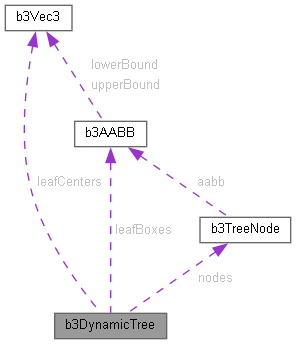
| Data Fields | ||
|---|---|---|
| int * | binIndices | Bins for sorting during rebuild. |
| int | freeList | Node free list. |
| b3AABB * | leafBoxes | Leaf bounding boxes for rebuild. |
| b3Vec3 * | leafCenters | Leaf bounding box centers for rebuild. |
| int * | leafIndices | Leaf indices for rebuild. |
| int | nodeCapacity | The allocated node space. |
| int | nodeCount | The number of nodes. |
| b3TreeNode * | nodes | The tree nodes. |
| int | proxyCount | Number of proxies created. |
| int | rebuildCapacity | Allocated space for rebuilding. |
| int | root | The root index. |
| uint64_t | version |
The dynamic tree version. Always the first field. Useful if the tree is serialized. |
| struct b3TreeStats |
| union b3TreeNode.__unnamed0__ |
| Data Fields | ||
|---|---|---|
| b3TreeNodeChildren | children | Children (internal node). |
| uint64_t | userData | User data (leaf node). |
| union b3TreeNode.__unnamed1__ |
| typedef float b3TreeBoxCastCallbackFcn(const b3BoxCastInput *input, int proxyId, uint64_t userData, void *context) |
This function receives clipped AABB cast input for a proxy.
The function returns the new cast fraction.
| typedef bool b3TreeQueryCallbackFcn(int proxyId, uint64_t userData, void *context) |
This function receives proxies found in the AABB query.
| typedef float b3TreeQueryClosestCallbackFcn(float distanceSqrMin, int proxyId, uint64_t userData, void *context) |
This function receives the minimum distance squared so far and proxy to check in the closest query.
| typedef float b3TreeRayCastCallbackFcn(const b3RayCastInput *input, int proxyId, uint64_t userData, void *context) |
This function receives clipped ray cast input for a proxy.
The function returns the new ray fraction.
| b3TreeStats b3DynamicTree_BoxCast | ( | const b3DynamicTree * | tree, |
| const b3BoxCastInput * | input, | ||
| uint64_t | maskBits, | ||
| bool | requireAllBits, | ||
| b3TreeBoxCastCallbackFcn * | callback, | ||
| void * | context ) |
Sweep an AABB through the tree.
The box is in the tree's world float frame and the callback re-differences each shape at full precision against the query origin. Used by the large world spatial queries so the tree traversal stays float while the narrow phase stays precise.
| b3TreeStats b3DynamicTree_Query | ( | const b3DynamicTree * | tree, |
| b3AABB | aabb, | ||
| uint64_t | maskBits, | ||
| bool | requireAllBits, | ||
| b3TreeQueryCallbackFcn * | callback, | ||
| void * | context ) |
Query an AABB for overlapping proxies.
The callback function is called for each proxy that overlaps the supplied AABB.
| b3TreeStats b3DynamicTree_QueryClosest | ( | const b3DynamicTree * | tree, |
| b3Vec3 | point, | ||
| uint64_t | maskBits, | ||
| bool | requireAllBits, | ||
| b3TreeQueryClosestCallbackFcn * | callback, | ||
| void * | context, | ||
| float * | minDistanceSqr ) |
Query an AABB for the closest object.
The callback function is called for each proxy that might be closest to the supplied point.
| tree | the dynamic tree to query |
| point | the query point |
| maskBits | nodes are skipped if the bit-wise AND with the node category bits is zero |
| requireAllBits | nodes are skipped if the bit-wise AND with the node category bits does not equal the maskBits |
| callback | a user provided instance of b3TreeQueryClosestCallbackFcn |
| context | a user context object that is provided to the callback |
| minDistanceSqr | the initial and final minimum squared distance. Provide a small initial to restrict the search and improve performance. If the value is large this query has performance that scales linearly with the number of proxies and would be slower than a brute force search. |
| b3TreeStats b3DynamicTree_RayCast | ( | const b3DynamicTree * | tree, |
| const b3RayCastInput * | input, | ||
| uint64_t | maskBits, | ||
| bool | requireAllBits, | ||
| b3TreeRayCastCallbackFcn * | callback, | ||
| void * | context ) |
Ray cast against the proxies in the tree.
This relies on the callback to perform an exact ray cast in the case where the proxy contains a shape. The callback also performs any collision filtering. This has performance roughly equal to k * log(n), where k is the number of collisions and n is the number of proxies in the tree. Bit-wise filtering using mask bits can greatly improve performance in some scenarios. However, this filtering may be approximate, so the user should still apply filtering to results.
| tree | the dynamic tree to ray cast |
| input | the ray cast input data. The ray extends from p1 to p1 + maxFraction * (p2 - p1) |
| maskBits | bit mask test: bool accept = (maskBits & node->categoryBits) != 0; |
| requireAllBits | modifies bit mask test: bool accept = (maskBits & node->categoryBits) == maskBits; |
| callback | a callback function that is called for each proxy that is hit by the ray |
| context | user context that is passed to the callback |
 1.17.0